

Introduction
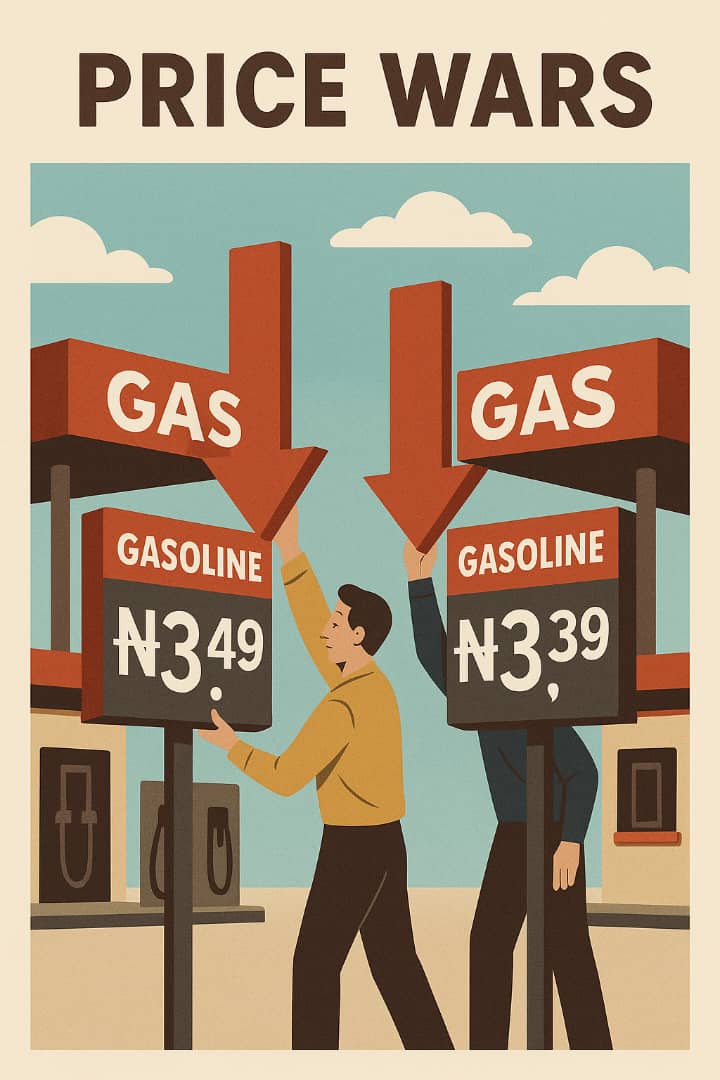
In the dynamic landscape of the downstream petroleum industry, especially in regions like Nigeria and other developing economies, petrol station operators constantly find themselves in a tug-of-war not just with fluctuating oil prices and regulatory hurdles but with aggressive price wars. These price wars, while intended to attract customers and boost market share, often reveal deep-rooted competitive gaps that hinder healthy competition and sustainable profitability.
Among the most critical, yet often overlooked, of these gaps is price visibility—the ability of a fuel station to boldly and clearly display its current pump prices to passing motorists. In today’s ultra-competitive environment, many stations offer some of the most competitive pricing but fail to communicate this to potential customers due to poorly designed or non-functional price boards (Totems). This single flaw often determines who gets the traffic and who stays idle.
This article explores the core competitive gaps affecting petrol station performance during price wars, with a strong emphasis on price visibility, while also presenting sustainable, world-class solutions to address these issues.
- The Centrality of Price Visibility
In a competitive pricing environment, where margins are razor-thin and customer loyalty is fluid, price visibility is everything. A well-lit, functional, and strategically positioned price totem is no longer a luxury; it is a business-critical necessity.
Common Issues:
Non-functional Totems: Power outages, neglect, or lack of maintenance often result in dark or blank price boards.
Poor Design: Some stations have Totems with small fonts or screens that are hard to read from a distance.
Lack of Real-Time Updates: Prices change, but boards aren’t updated promptly, confusing customers.
Strategic Oversight: Some stations intentionally hide their prices to force customers into inquiries—this is counterproductive during a price war.
Recommendation
Installation of Digital LED Totems with Bold Fonts Size: Invest in high-resolution, backlit LED displays that remain visible day and night. These should be readable from at least 100 meters.
Real-Time Pricing Systems: Integrate POS systems with digital boards for automatic updates.
Branding-Integrated Totems: Design boards that not only show price but align with your corporate image, reinforcing trust and consistency.
Solar Back-up for Price Boards: Ensure continuous visibility even during blackouts with solar power systems.
- Poor Customer Communication Channels
In an era where mobile communication is widespread, petrol stations are still stuck in traditional models. Many fail to inform customers of price cuts, loyalty programs, or promotions.
Recommendations:
Use of Social Media & SMS: Build WhatsApp and SMS broadcast groups for frequent customers. Push price updates and promotions.
Dedicated Mobile App or Web Portal: Some leading global brands have apps that display real-time prices and fuel availability across locations.
- Weak Brand Identity and Service Differentiation
When price is the main battlefield, non-price elements must become the edge. Many stations fail to build a brand identity that distinguishes them even when prices are similar.
Factors to Consider:
Cleanliness of forecourt
Staff uniform and training
Speed of service
Security and lighting
Availability of alternative fuels (e.g., LPG, CNG)
Recommendations:
Invest in Brand Experience: Train attendants in customer engagement. Use uniforms, professional greeting, and prompt service to set a tone.
Modern Station Design: Upgrade signage, use clean and minimalist design for appeal.
- Inconsistent Product Quality and Measurement
[08:39, 16/05/2025] MOGBOGU CHINONSO CHRIS:
Inconsistencies in fuel quality and short dispensing volumes destroy trust faster than any price difference. Even during a price war, if customers do not trust your liters or fuel quality, they won’t return.
Recommendations:
Calibration with Digital Meters: Invest in digital metering and certification displayed visibly at the pump.
Third-Party Quality Assurance: Get recognized bodies to certify your fuel quality regularly.
Daily Customer Feedback System: A feedback card or digital QR code at the pump allows customers to report service quality or suspicion instantly.
- Poor Location Branding and Access
During price wars, customers may still ignore your station if access is poor or visibility is limited from key road angles.
Recommendation:
Directional Signage: Use branded road signs 200–300 meters away, especially at traffic stops or intersections.
Access Road Maintenance: Work with local governments or invest in your own entry and exit road upgrades.
Night Visibility Enhancements: Floodlight the station and use reflective branding materials.
- Non-Leveraging of Loyalty Programs
While developed markets leverage loyalty cards and mobile fuel credits, many local operators lag in offering rewards for repeated patronage.
Recommendation:
Digital Loyalty Systems: Use cards or mobile-linked systems that reward customers with points per liter.
Incentivize Referrals: Give free liters or discounts to customers who refer others.
- Lack of Data-Driven Strategy
Most stations rely on intuition rather than performance data to make business decisions during a price war.
Recommendation:
Install Fuel Management Software: Track inflow, outflow, customer patterns, and top-selling times.
Daily Price Watch Team: Assign staff to monitor competitors and update pricing strategies accordingly.
8. Strengthening Brand Integrity via Increasing Company-Owned Petrol Stations
In the dynamic landscape of Nigeria’s petroleum retail sector, the integrity of a brand plays a crucial role in sustaining customer loyalty and trust. One of the often overlooked strategies to preserve this integrity—especially during periods of heightened competition such as price wars—is the deliberate increase in company-owned petrol stations while limiting the number of affiliate or franchise outlets.
Company-owned stations are typically more aligned with corporate values and operational standards. They are directly managed by the parent company, which ensures strict compliance with pricing policies, product quality control, and service ethics. These stations are less likely to engage in sharp practices such as tampering with fuel pumps, selling unauthorized or adulterated products, or hoarding fuel during scarcity—practices more frequently reported among franchise stations seeking to maximize profit margins with limited oversight.
In contrast, franchise or affiliate stations—though useful for rapid brand expansion—often prioritize personal gain over corporate reputation. With less direct supervision, these outlets can become hotbeds for unethical behavior that damages customer trust and dilutes the brand’s credibility.
By increasing the number of company-owned stations, petrol brands not only maintain consistency in pricing and service delivery but also build a stronger, more accountable network that customers can rely on. This strategy becomes even more vital during competitive price wars, where uniformity and integrity can be the distinguishing factor that retains loyal customers and attracts new ones.
A long-term investment in company-owned stations is ultimately a commitment to quality, transparency, and sustainability in the retail petroleum market
9. Price Forecasting:
In the fiercely competitive petrol station industry, price wars can quickly erode profit margins and destabilize business operations. When fuel retailers engage in aggressive price undercutting to attract customers, those without a strategic pricing approach, risk significant losses. This is where price forecasting becomes a critical tool for survival and profitability.
Some Reasons Why Price Forecasting Matters:
1. Maintaining Profit Margins
– Fuel prices fluctuate due to global oil markets, local taxes, and competitor actions.
– Accurate forecasting helps petrol stations adjust prices proactively rather than reactively, ensuring sustainable margins even in a price war.
2. Competitive Positioning
– Knowing when and how much competitors might drop prices allows businesses to strategically match or undercut without engaging in destructive pricing.
– Historical data and trend analysis help predict competitor moves before they happen.
3. Inventory & Purchase Optimization
– Buying fuel at the right time (before expected price hikes) maximizes profit.
– Forecasting prevents overstocking before a price drop or shortages before a surge.
4. Customer Retention & Attraction
– Consumers are highly price-sensitive; a well-timed price adjustment can draw in more customers without sacrificing profitability.
– Loyalty programs and dynamic pricing (based on forecasts) enhance customer retention.
5. Risk Mitigation
– Unpredictable price swings can lead to cash flow problems.
– Forecasting models help minimize financial risks by anticipating market shifts.
How to Implement Effective Price Forecasting
– Use historical pricing data to identify trends.
– Monitor global oil prices and geopolitical factors affecting supply.
– Track competitor pricing strategies in real-time.
– Leverage AI and pricing software for predictive analytics.
In a market where every cent per liter counts, petrol stations that leverage price forecasting gain a decisive edge. Instead of being swept up in chaotic price wars, smart retailers use data-driven strategies to protect profits, attract customers, and stay ahead of competitors.
Conclusion
Healthy competition in the petrol station business, especially during aggressive price wars, hinges not only on who offers the lowest price but who communicates it best. Price visibility, as simple as it seems, could be the most powerful competitive advantage in today’s volatile fuel market.
Yet, it is only one piece of the puzzle. Stations must also improve customer experience, use modern branding techniques, invest in real-time communication, ensure fuel integrity, and harness the power of data and loyalty.
A holistic, world-standard approach will not only help petrol stations survive price wars but emerge as trusted, long-term players in a highly competitive marketplace.